1. Core Thesis
The tokenization of real-world assets (RWA) — such as real estate, bonds, and commodities — is rapidly transforming blockchain from a speculative arena into the foundational infrastructure layer of global finance.
These tokenized assets offer 24/7 accessibility, global transferability, and enhanced liquidity — features that were previously reserved for institutions or high-net-worth individuals.
- Overall Market Growth
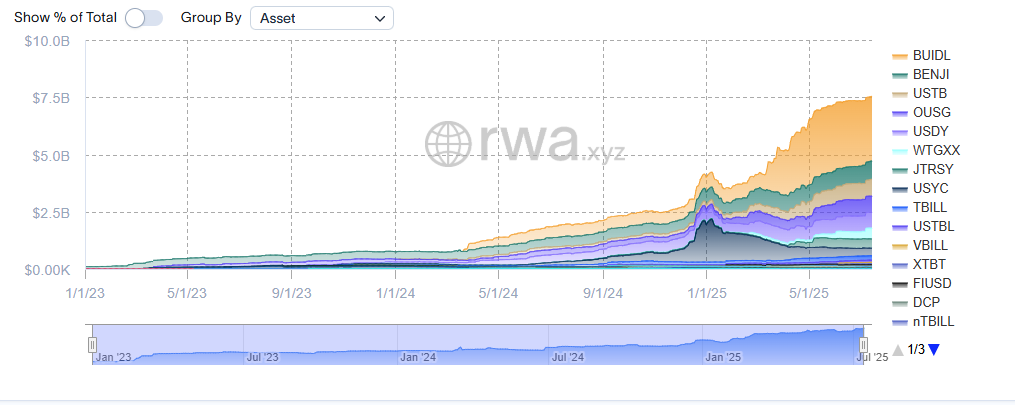
- 2022: On-chain RWA market cap ≈ $5B.
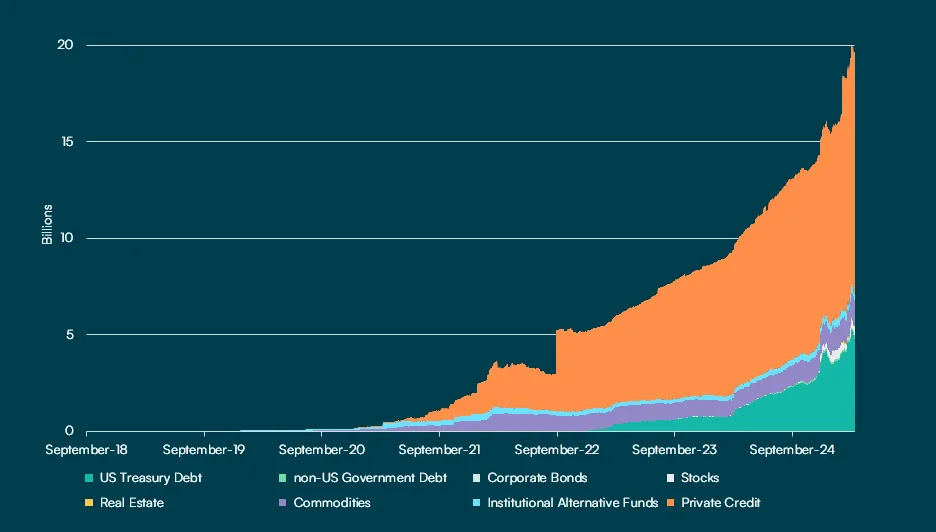
- Mid-2025: RWA market ≈ $24B, up 380% (some sources report 308%, directionally consistent with exponential growth).
- Q2 2025: Tokenized RWA surpassed $25B, representing a 245× increase since 2020.
2. Segment-Level Growth
- Bonds & Money Market Funds (MMFs): From early 2025 to mid-year, this segment rose 80% to $7.4B.
- Private Credit: Accounts for $14B of the $24B market, making it the largest single RWA segment.
3. Platform TVL (Total Value Locked) Examples
- Centrifuge: As a multi-chain RWA platform, TVL ≈ $440M (2025).
- RWA.xyz (Sep 2025): On-chain RWA total value ≈ $28.44B
4. Leading Platforms & Exchange Deployments
Crypto Platforms
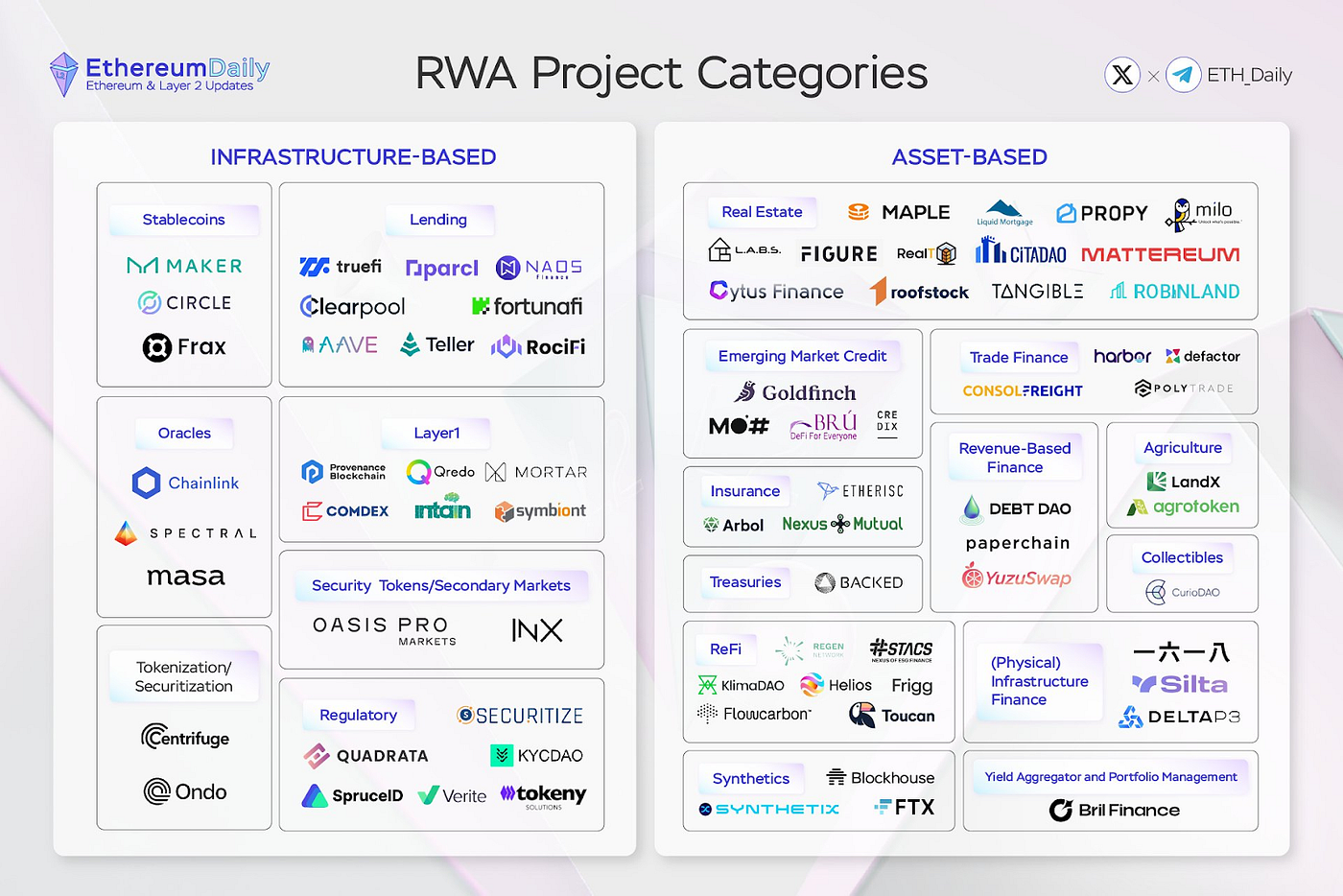
- Centrifuge — DeFi-native RWA infrastructure, TVL > $1B (2025); core products include Tinlake & Launchpad.
- Securitize — Compliance gateway; issued and manages BlackRock’s BUIDL; AUM > $2.8B; largest tokenized equity: Exodus ($400M).
- BNB Chain — Hosts Franklin Templeton’s BENJI, VanEck’s VBILL, XAUm (gold token); diversified RWA activity across bonds, MMFs, and gold.
- Binance — RWA market grew from $8.6B → $23B (+260%) in H1 2025; launched ALLO as an RWA ecosystem token.
- Coinbase — RWA market expanded from $85M (2020) → $21B (2025), a 245× increase; advancing tokenized equities, estimating that capturing just 3% of global equity markets could double crypto’s market cap.
- Kraken — Via partnership with Backed, launched xStocks with cumulative trading volume > $35B; expanding into BNB Chain to scale tokenized equities.
Traditional Financial Institutions
- Morgan Stanley — In June 2025, launched “HL” RWA token on Volcano Exchange (VEX), tied to Private Bank revenue rights; issued 200M tokens ($20M value).
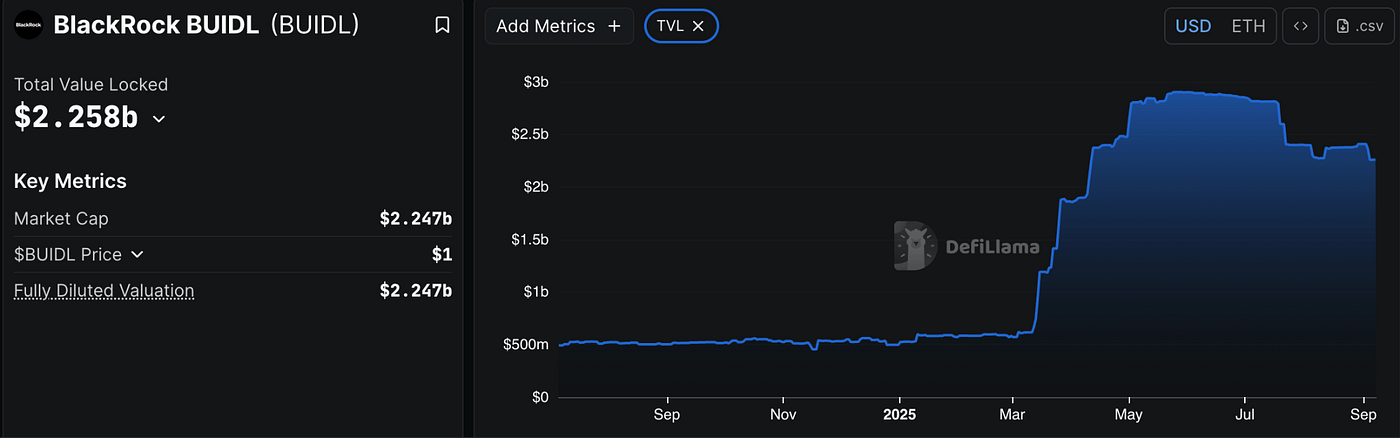
- BlackRock — Launched BUIDL (tokenized MMF) in March 2024; AUM crossed $1B by Mar 2025, peaked near $2.9B in June; as of Sep 2025, AUM ≈ $2.24B. BUIDL is accepted as collateral on Crypto.com and Deribit.
3. Merrill Lynch / Bank of America — No direct RWA products disclosed; however, BofA (Aug 2025) published research highlighting accelerated tokenization of assets from real estate to equities, and maintains ongoing blockchain/tokenization patent filings.
5. Why VCs Should Enter RWA Now
- Market Inflection Point
- Explosive growth: $5B (2022) → $25–28B (2025).
- Structural shift: from experimental debt pools to mainstream T-bills, MMFs, private credit, equities, real estate.
- Risk-return profile: RWAs provide stable yield + compliance, filling a gap where crypto lacks sustainable cash flow.
2. Deep Institutional Entry
- BlackRock BUIDL > $2B AUM, accepted as collateral.
- Morgan Stanley piloting private banking RWA tokens ($20M).
- Franklin Templeton & VanEck have launched tokenized treasuries/funds.
- Coinbase, Binance, Kraken building RWA trading, collateral, and secondary liquidity infrastructure.
3. Policy Momentum
- Hong Kong: SFC & HKMA advancing tokenized funds/bonds; active sandbox.
- Singapore: MAS Project Guardian shifting from pilot to production.
- EU: DLT Pilot Regime & MiCA establishing legal clarity.
4. Strategic Value for Venture Capitals
- Differentiation: Compared to internet/consumer, RWA is a true “blue ocean” VC track.
- Risk Hedge: Provides stable yields to balance volatile crypto-native bets.
- Resource Leverage: Bridge between China/APAC capital + global projects.
- Long-Term Positioning: RWA is the starting point of financial digitalization — early entry = first-mover advantage in the future on-chain capital markets.
6. Where Value Will Accrue
Cash-like RWAs (T-Bills, MMFs)
- Cases: BlackRock BUIDL ($2.2B+), Franklin FOBXX, VanEck VBILL
- Data: $7.4B (H1 2025), largest category
- Implication: Dominates near-term; VC focus = rails/infrastructure
Private Credit & Real-World Lending
- Cases: Maple Finance ($2.6B loans), Centrifuge ($1B TVL), Goldfinch
- Data: $14B (2025), largest segment
- Implication: VC opportunities = credit protocols, risk infra, KYC wallets
Tokenized Funds & Equities
- Cases: Kraken x Backed xStocks ($35B+ volume), Coinbase tokenized equities, Superstate USTB
- Implication: Long-term upside = secondary liquidity & compliance issuance
Commodities & Others (Gold, Real Estate, Carbon Credits)
- Cases: Paxos PAXG, XAUm (BNB Chain), Tangible (real estate NFTs)
- Implication: Smaller but strong narrative; ESG & green finance optionality
7. Enabling Infrastructure (VC Opportunity Set)
- Tokenization Service Providers: Securitize, Ondo Finance (OUSG), Backed
- Legal/Compliance Middleware: Polymesh, Blockpass (KYC/AML), Fireblocks (custody rails)
- Oracles & Transparency: Chainlink Proof of Reserve (BUIDL), RWA.xyz
- Custody & Secondary Liquidity: Anchorage, Coinbase Custody, HK-licensed VASPs
8. APAC Geostrategic Edge
- Hong Kong: Tokenized funds authorized; HKMA issued green bonds; strong demand from banks & family offices.
- Singapore: MAS Project Guardian going production; likely to set Asia’s regulatory standard.
- China & Middle East: Middle East sovereign funds exploring tokenized bonds; RMB-denominated products could be a long-term breakthrough.
9. Risks & Constraints
- Legal Finality Risk: Lack of clarity whether on-chain transfers = legal ownership.
- Liquidity Fragmentation: Whitelist-only access limits secondary liquidity.
- Counterparty Risk: Insolvency of issuers leaves unclear recourse for token holders.
- Regulatory Divergence: Divergent regional regimes may create friction for cross-border adoption.
Conclusion
RWA is shifting from narrative to reality: the market has grown nearly fivefold in three years, with segments now spanning cash-like assets, private credit, tokenized funds and equities, as well as commodities. Web3 platforms, centralized exchanges, and Wall Street institutions are all deeply engaged, driving RWA from experimentation into mainstream financial infrastructure.
RWA is not only a new growth engine but also a unique investment blue ocean that combines regulatory compliance, stable cash flows, and long-term scalability. Leveraging its positioning in China and the broader Asia-Pacific region can establish a first-mover advantage by deploying into infrastructure, credit protocols, and compliant issuers.


Leave a comment